When you move to a new country, you feel like you're living on Mars for awhile. Everything is unique and different. The smallest comment from a native can generate a laugh or an insightful comment into the subtle differences separating your two countries. Eventually though, you settle in. You develop a routine. The place isn't home, but you carve out a niche and find some local comforts, or maybe spend a little too much money buying some from your homeland. You never forget that you're in a foreign place, but you adjust.
I think that's the point that C and I have hit this week. Our families know that we've been struggling a bit with teaching - and no matter where you are or what you're doing, your job is a big part of your life. If it's a struggle then the whole of your existence can be trying at times. The lesson here is pretty straightforward. No matter where you go and no matter what you do, you've got to find the something more that makes life worthwhile. For us, that's our faith and our family and a belief that every experience in life has a purpose. We're not in China just because it's a great place to be a tourist and I can assure it's not because we love teaching English to unmotivated Chinese university students. Just like everything else, it's preparing us for some future step in life.
It's weeks like this where I dwell on these things, primarily because I am pretty frustrated with teaching. You'll find a number of different attitudes from the other English teachers. Some of them don't care much at all. They do what they have to get by and little more. Others like teaching and spend all class long playing games but I am not convinced they ever teach the students anything. Finally, the last set actually care to impart knowledge to the students but are frustrated to no end by the peculiarities of trying to teach English here. I won't lie - I have been in each category. Sometimes in the same day my attitude will shift from to the other.
Here's why teaching here can be difficult-
1) Skill level varies tremendously between students. The freshmen I have are closer in ability than the juniors but it's still a wide range.
2) The students lack a tremendous amount of vocabulary. Our class is Oral English I. The book we use is primarily to get students to speak and to practice pronunciation. And that's all well good but it's hard to have even a basic conversation if you don't know certain words. But I don't have a vocabulary book to use to teach them with even if I could incorporate it.
3) Students almost NEVER raise their hand. At first I didn't mind calling on people but it's really frustrating after awhile when you ask really easy yes or no questions and not a single person will bother. You have to call on them every time.
4) You can plan a very detailed lesson and have it fail. Teaching requires a lot of effort. You have to plan and then present in class. Then in class you have to adjust on the fly to how students are responding. Are they learning? Is it interesting? Do I need to move to something else if they don't like this, or do I force them to do it?
My mother is a teacher and I know she is a good one. Being here has given me even more respect for her than I had before. And she teaches "at-risk" youth, which makes teaching ESL look like a day at the beach. Teaching is not easy! I am now amazed at the good teachers and professors I had in school and in college. And now I understand why the bad ones were bad. When you work a 9-5, you can have a good hour at work and produce something that made the whole 8 hours worthwhile. As a teacher, you prepare beforehand, then you have to present the preparation well. Finally, you have to give good out of class assignments and deal with grading them. If you fail at any step along the way, they don't learn - and to top it off, you may feel awkward in class knowing that the lesson is a partial failure. Teaching is the curse of caring. I used curse there primarily for the alliteration - but it often feels like those who long to do good are fighting an uphill battle.
My hometown newspaper has a regular column called "The Vent" where people call in to express their frustration about some local (usually insignificant) issue. I guess this is my Vent entry! I don't think they will publish it in the China Daily though.
Wednesday, October 11, 2006


Saturday, October 07, 2006
C - on absorbing (culture) shock
Sometimes I feel that China is a rubik's cube that I'm ever so slowly putting in order. Week by week, I notice that the signs and billboards are revealing more and more bits of their meaning and that conversations are becoming less and less unintelligible to me. It's a good feeling.
It's exhilarating to feel the blinders coming off, the clouds clearing up, the little mysteries being solved. Every little thing I figure out fuels my motivation to keep studying, keep practicing, keep trying. But then China gets in the way. Just when I start to feel even moderately adjusted, confident, and content, China finds some new way to offend, annoy, horrify, or confound me. And then I don't want to talk to ANY Chinese people, and if I don't want to do that, why would I study the language?
But the point of this entry is not to rant about Chinese culture. I do that vicariously through talktalkchina.com. The thought that's been brewing in my head all day is amazement at the people I know whose parents (or they themselves as children) emigrated from China or Korea. I knew in my mind that these cultures were different from that of the United States, but living here in China has caused me to grasp more fully the enormity of the fundamental incompatibility that exists between East and West.
At our old church in New Jersey (www.emetro.org), we met and became friends with a good amount of first-generation Americans. These people were proud of their Asian heritage and (rightfully) considered it an important part of their identity, but I didn't feel an enormous gulf separating us like the one that exists between me and the Chinese people here in China. Sometimes I feel like I have absolutely nothing in common with the people here.
Obviously my friends' parents felt they weren't completely incompatible with life in the US if they moved their family there, but I'm amazed at the open-mindedness both they and their children seem to possess in order to be able to function in both cultures. So, P, J, A/Y, S/P, S, K, Y, and anyone else I might have failed to think of, if you're reading this, please know that I think you guys are amazing. Right now I need to take a lesson from your great example!
It's exhilarating to feel the blinders coming off, the clouds clearing up, the little mysteries being solved. Every little thing I figure out fuels my motivation to keep studying, keep practicing, keep trying. But then China gets in the way. Just when I start to feel even moderately adjusted, confident, and content, China finds some new way to offend, annoy, horrify, or confound me. And then I don't want to talk to ANY Chinese people, and if I don't want to do that, why would I study the language?
But the point of this entry is not to rant about Chinese culture. I do that vicariously through talktalkchina.com. The thought that's been brewing in my head all day is amazement at the people I know whose parents (or they themselves as children) emigrated from China or Korea. I knew in my mind that these cultures were different from that of the United States, but living here in China has caused me to grasp more fully the enormity of the fundamental incompatibility that exists between East and West.
At our old church in New Jersey (www.emetro.org), we met and became friends with a good amount of first-generation Americans. These people were proud of their Asian heritage and (rightfully) considered it an important part of their identity, but I didn't feel an enormous gulf separating us like the one that exists between me and the Chinese people here in China. Sometimes I feel like I have absolutely nothing in common with the people here.
Obviously my friends' parents felt they weren't completely incompatible with life in the US if they moved their family there, but I'm amazed at the open-mindedness both they and their children seem to possess in order to be able to function in both cultures. So, P, J, A/Y, S/P, S, K, Y, and anyone else I might have failed to think of, if you're reading this, please know that I think you guys are amazing. Right now I need to take a lesson from your great example!
D - Shenyang Concluded
We have returned from Xi'an and I'm still writing about Shenyang. When you have a lot to work on and a lot to say it's easy to get behind. I finally decided to use the Google Picasa Photo Albums so now we can just upload all our pictures and you can view them at your leisure. The general link to all our photos will be this and the Shenyang specific link is here.
I want to close out Shenyang with a video. It's the usual handheld herky-jerky-likely-to-make-you-ill variety, but it will give you a sense of the energy that a Chinese city can have. The energy is why many people come to China. Even in New York City, it's hard to find the same kind of excitement and adrenaline. The street in Shenyang featured hundreds of people milling about - shopping, talking, laughing, eating. Some western cities have one-off events that feature this level of atmosphere but in China it happens everyday. If you hate crowds, it can be maddening but if you let go of your personal space for a few minutes it can be truly exhilarating. The night markets in China are quite a sight. The peddlers have DVDs, socks, bras, candy, cell phones, terra cotta soldiers, and trinkets out the wazoo.
Without further ado, the video.
I want to close out Shenyang with a video. It's the usual handheld herky-jerky-likely-to-make-you-ill variety, but it will give you a sense of the energy that a Chinese city can have. The energy is why many people come to China. Even in New York City, it's hard to find the same kind of excitement and adrenaline. The street in Shenyang featured hundreds of people milling about - shopping, talking, laughing, eating. Some western cities have one-off events that feature this level of atmosphere but in China it happens everyday. If you hate crowds, it can be maddening but if you let go of your personal space for a few minutes it can be truly exhilarating. The night markets in China are quite a sight. The peddlers have DVDs, socks, bras, candy, cell phones, terra cotta soldiers, and trinkets out the wazoo.
Without further ado, the video.
Sunday, October 01, 2006
D - On the road again
Well, now we're headed to Xi'an with our Danish friends. I haven't even finished uploading the entries about Shenyang...but what can you do. We will be back next Thursday evening with another boatload of pictures. With our additional classes this last week time was at a premium, but fear not loyal readers, we will continue posting for your vicarious China enjoyment.
Until then
再见
Until then
再见
Saturday, September 30, 2006
D - Shenyang Part 2 - The Exposition
After getting off the train Friday night, we found a very nice taxi driver to take us to our hotel. He was Shenyangese and claimed he could be an excellent tour guide. Sylvia judged him to be trustworthy so we invited him to pick us up at 8am the next morning to take us to the Exposition. The Expo was located about 15km east of Shenyang city and was surrounded by a very beautiful countryside. Only the faint tinge of brown on the horizon could detract from the views around the Expo grounds.
The Exposition began at the end of May and continues through the end of October 2006. So we were catching it at the end of its life. Despite this, overall it was a good experience. One thing you have to remember when judging it is that it's in China. In other words, even if the presentation is bad, it would be good, because we're learning how other people do things and what exhibits are interesting to their mind. Anyway, I would liken it almost more to a World's Fair than a Horticultural Exposition. There were two main categories of sites - Chinese Domestic Exhibitions and International Exhibitions. Each site had plants and gardens from the respective region or country, but there were also stores selling (supposedly) unique items from their culture. Strange how Malaysia, Thailand, and Myanmar all seemed to be selling the same stuff! Of course, my favorite display was put on by Turkey. They didn't actually setup a garden or sell any kitsch, but they grilled up some mean mutton kebabs - very tasty! Our only non-food purchase of the day was made at the India garden where C picked up some incense.
And here are the pictures...starting with the entrance to the exposition. We have many more than this but I still haven't found a photo gallery site I like yet.

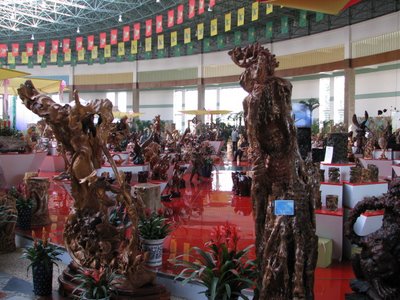
Some interesting tree root art
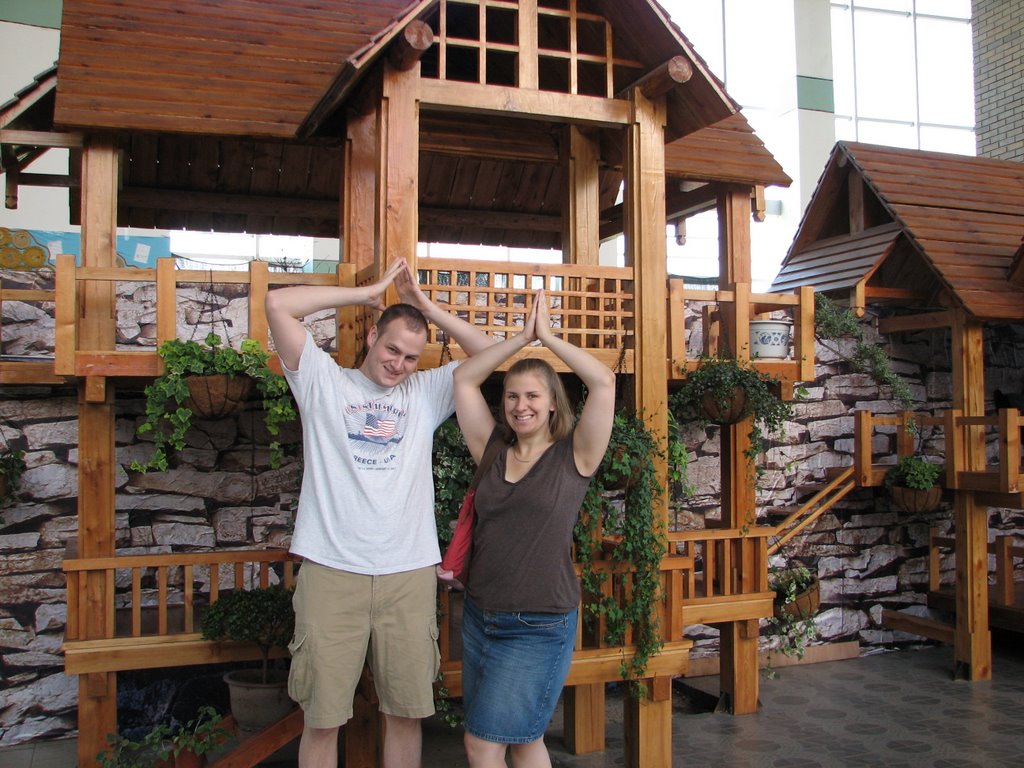
Doing a "Miao" dance in front of a prototypical "Miao" home

One of the many China Regional Gardens. Who's the funny white guy?

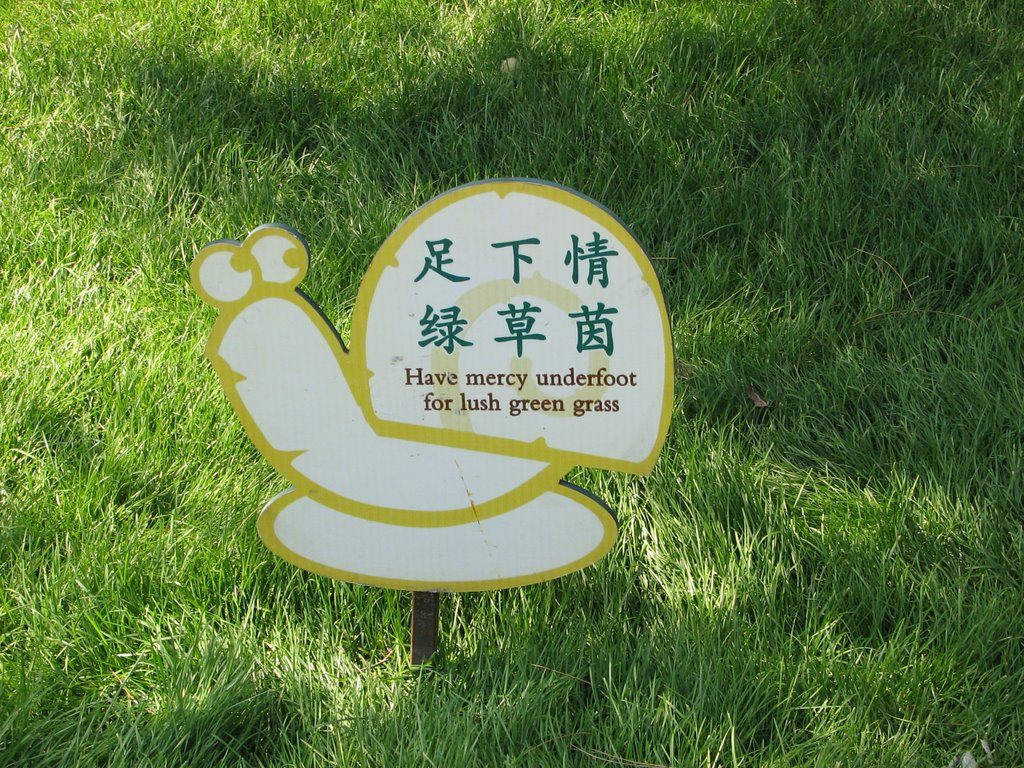
Chinese sentiments can seem cheesy to a Westerner

Something you won't see at a US Exposition: A North Korean booth

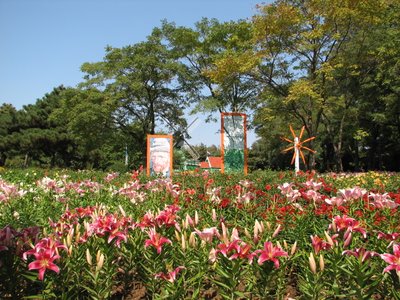
The Lily Tower built for the exposition

Something else you won't see at a US Exposition: a ropes course??

The Dutch Garden sporting some Van Gogh
The American garden seeks to educate about great American leaders like Washinglon and Einstin.


Sylvia and Cassie hanging out in front of the Italian garden

A rose is a rose

The Exposition began at the end of May and continues through the end of October 2006. So we were catching it at the end of its life. Despite this, overall it was a good experience. One thing you have to remember when judging it is that it's in China. In other words, even if the presentation is bad, it would be good, because we're learning how other people do things and what exhibits are interesting to their mind. Anyway, I would liken it almost more to a World's Fair than a Horticultural Exposition. There were two main categories of sites - Chinese Domestic Exhibitions and International Exhibitions. Each site had plants and gardens from the respective region or country, but there were also stores selling (supposedly) unique items from their culture. Strange how Malaysia, Thailand, and Myanmar all seemed to be selling the same stuff! Of course, my favorite display was put on by Turkey. They didn't actually setup a garden or sell any kitsch, but they grilled up some mean mutton kebabs - very tasty! Our only non-food purchase of the day was made at the India garden where C picked up some incense.
And here are the pictures...starting with the entrance to the exposition. We have many more than this but I still haven't found a photo gallery site I like yet.

Some interesting tree root art

Doing a "Miao" dance in front of a prototypical "Miao" home
One of the many China Regional Gardens. Who's the funny white guy?

Chinese sentiments can seem cheesy to a Westerner
Something you won't see at a US Exposition: A North Korean booth

The Lily Tower built for the exposition

Something else you won't see at a US Exposition: a ropes course??

The Dutch Garden sporting some Van Gogh

The American garden seeks to educate about great American leaders like Washinglon and Einstin.


Sylvia and Cassie hanging out in front of the Italian garden
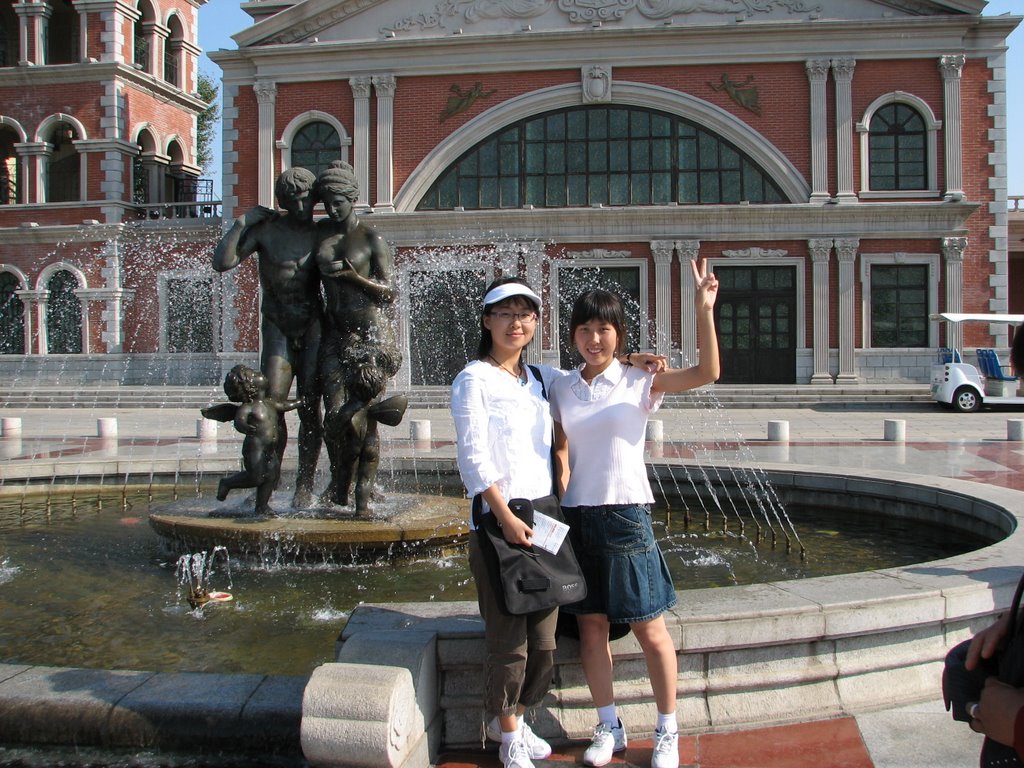
A rose is a rose

Wednesday, September 27, 2006
D - Shenyang Part 1 - The Train
Well we have returned successfully from our first intra-China travel experience. It began Friday afternoon when we met our student volunteer Sylvia and her roommate Cassie at the closest bus stop. We took the 502 downtown and got off near the train station, which was the haven of madness we expected. Not only was it packed to the brim with everyday Chinese travellers, but there were hundreds of soldiers everywhere, apparently headed off from Dalian to fill the train station of another city. We were about an hour early for the train so we hung out in the waiting area. There were probably a 1000 people milling about where we were and we felt like every single one of them was staring at us. People would be minding their own business and then make a sudden veer our way. They would inquire in Chinese with our friends as to where we were from and what we were doing. Sylvia explained that many people who travel by train are farmers who may have never seen a foreigner before - and I believe it. The tickets for our friends to Shenyang were 15 RMB - about $1.90! China's train system make it possible for even the poorest to get transportation.
Right before we headed to get on the train at 3:30, I decided to hit the WC. Now the bathroom in any public place like the train station is never nice, but this was a whole new level of unniceness. Actually, the bathroom itself was no worse than your average interstate rest stop, but the air was literally like breathing pure tobacco smoke. You can't smoke in the train station central area (and it's actually enforced), but I know where they go to get their fix! Ugh. Finally, we got on the train. Sadly, we don't have any pictures of the station or the train. From the outside, it was a pale green and looked every bit to be from a bygone communist era. I should add that we took the 2209 train, which is the slowest and least comfortable train. From what I read, there are some very nice trains here but our students of course chose the most economic option.
There are four classes of seats on most Chinese trains: hard seats, soft seats, hard sleeper, and soft sleeper - if you're curious on the distinctions, click here. The picture of the hard seats (our class) is relatively close to our experience with a few exceptions. For example, MANY people in China will stand in the hard seat compartments for incredibly long journeys. Having an aisle seat isn't as advantageous when you have people roaming up and down hoping to find a spare seat, or maybe just leaning on your seat. I was talking to a student today and he told me that to get from his home in central China to Dalian, he would STAND for 22 hours. Another girl got to sit on her train journey to Dalian, but it took 50 hours from her home in Gansu province.
Thankfully we didn't need the restroom on the train so I can't report any findings there. Our dinner consisted of ramen noodles brought by our friends. You can get hot water on the train to make that sort of ready-to-eat dish. The journey itself was okay - there were probably 6 or 7 stops of 3-10 minutes on the way to Shenyang. My bottom was certainly ready to get off though at the 6 hour and 15 minute mark when we arrived at the Shenyang North train station.
Right before we headed to get on the train at 3:30, I decided to hit the WC. Now the bathroom in any public place like the train station is never nice, but this was a whole new level of unniceness. Actually, the bathroom itself was no worse than your average interstate rest stop, but the air was literally like breathing pure tobacco smoke. You can't smoke in the train station central area (and it's actually enforced), but I know where they go to get their fix! Ugh. Finally, we got on the train. Sadly, we don't have any pictures of the station or the train. From the outside, it was a pale green and looked every bit to be from a bygone communist era. I should add that we took the 2209 train, which is the slowest and least comfortable train. From what I read, there are some very nice trains here but our students of course chose the most economic option.
There are four classes of seats on most Chinese trains: hard seats, soft seats, hard sleeper, and soft sleeper - if you're curious on the distinctions, click here. The picture of the hard seats (our class) is relatively close to our experience with a few exceptions. For example, MANY people in China will stand in the hard seat compartments for incredibly long journeys. Having an aisle seat isn't as advantageous when you have people roaming up and down hoping to find a spare seat, or maybe just leaning on your seat. I was talking to a student today and he told me that to get from his home in central China to Dalian, he would STAND for 22 hours. Another girl got to sit on her train journey to Dalian, but it took 50 hours from her home in Gansu province.
Thankfully we didn't need the restroom on the train so I can't report any findings there. Our dinner consisted of ramen noodles brought by our friends. You can get hot water on the train to make that sort of ready-to-eat dish. The journey itself was okay - there were probably 6 or 7 stops of 3-10 minutes on the way to Shenyang. My bottom was certainly ready to get off though at the 6 hour and 15 minute mark when we arrived at the Shenyang North train station.
Thursday, September 21, 2006
D - Holy Shenyang Batman!
Well, this entry will be the last for a few days. We're one week away from our trip to Xi'an and somehow we managed to get another trip together. Our student volunteer was going to the International Horticultural Exposition in Shenyang, China this weekend with her roommate and we asked her if we could tag along. Shenyang is a heavily industrial city about 6 hours north of Dalian by train. The pronunciation sounds like "Shunyahng" according to the Chinese pinyin phonetic system. It's the capital of Liaoning province. Once known as Mukden, it was a hub of industry setup by the Japanese during their occupation of Manchuria during the second Sino-Japanese War. Throughout the 60s and 70s it was among the most successful industrial cities in China, but as market reforms took place in the 80s and 90s it fell behind some of the other cities. It's supposed to be rather dirty and polluted so I suspect this exposition is an effort to try and rebuild some of its reputation.

Ironically, my father has actually been to Shenyang. He gave a speech that was broadcast on state TV in the mid 90s. He gives an interesting description of his visit there. His company was investing about $50,000 in a local Chinese firm, which is pretty small. The hosts of his visit however went all out with a huge banquet and celebration at this magnificent occasion of Sino-American partnership!
The trip will see a number of firsts for me (C is far more Chinaperienced with her study abroad trip so this is old hat for her).
First stay at a Chinese hotel
First train trip in China
First visit to Shenyang
First trip with Chinese friends
One of the firsts I hope to avoid is - "First time using a squat toilet while going around a curve on a Chinese train"!
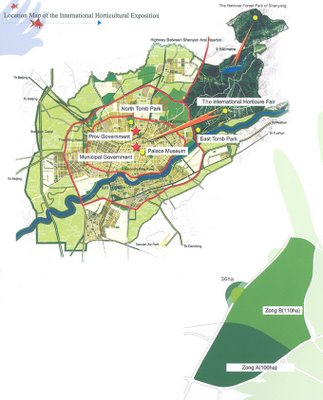
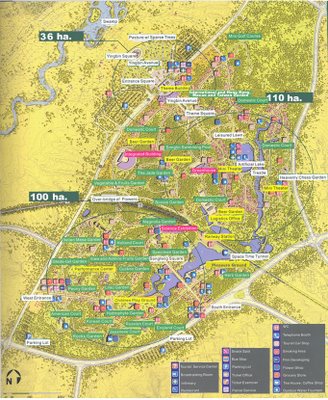
Some maps from the exposition web site are below...in English.

Ironically, my father has actually been to Shenyang. He gave a speech that was broadcast on state TV in the mid 90s. He gives an interesting description of his visit there. His company was investing about $50,000 in a local Chinese firm, which is pretty small. The hosts of his visit however went all out with a huge banquet and celebration at this magnificent occasion of Sino-American partnership!
The trip will see a number of firsts for me (C is far more Chinaperienced with her study abroad trip so this is old hat for her).
First stay at a Chinese hotel
First train trip in China
First visit to Shenyang
First trip with Chinese friends
One of the firsts I hope to avoid is - "First time using a squat toilet while going around a curve on a Chinese train"!
Some maps from the exposition web site are below...in English.


Subscribe to:
Posts (Atom)